Structural Analysis & Design

Seismic & Wind Load Analysis

Structural Engineering Services specialises in evaluating structures for site-specific seismic and wind actions per local codes.

Quick answer

Seismic & Wind Load Analysis is the process of evaluating structures for site-specific seismic and wind actions per local codes. Structural Engineering Services delivers it worldwide on licensed STAAD.Pro, RAM Connection, Foundation Advanced to AISC 360, ASCE 7, EN 1993 and client specifications.

1,200+
Projects delivered
40+
Countries served
60+
In-house engineers
2009
Engineering since

Software we use

  • STAAD.Pro
  • RAM Connection
  • Foundation Advanced

Why us

Why choose us for seismic & wind load analysis

Whether you are a fabricator racing a shop schedule, an EPC contractor managing multiple disciplines or an owner needing an independent check, our seismic & wind load analysis team works as an extension of yours. Every deliverable passes a two-stage check by senior engineers before it leaves our office.

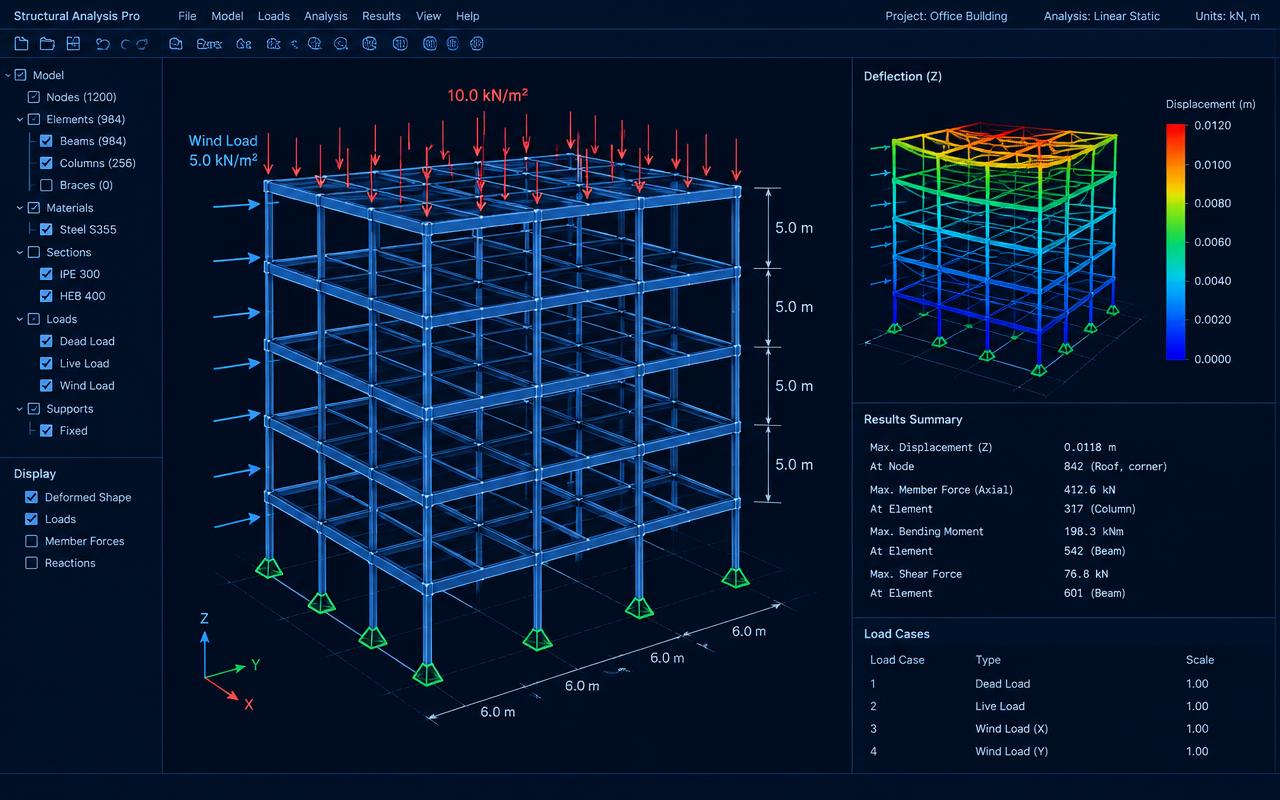
Seismic & Wind Load Analysis example

Deliverables

What you receive

The standard structural analysis & design package. Anything outside it is priced as a named add-on, never assumed.

01

Analysis model & load combinations

02

Design calculation report

03

Connection design sheets

04

Foundation load & design report

05

Marked-up design drawings

06

Peer-review ready summaries

Compliance

Codes & standards

Every seismic & wind load analysis package is engineered to the governing codes below and to any client or authority specification you issue with the enquiry.

  • AISC 360
  • ASCE 7
  • EN 1993
  • IS 800
  • ACI 318

Free quote

Need seismic & wind load analysis?

Send drawings and get a fixed-price proposal within 24 hours.

Request a Quote

Who we work with

Four kinds of client buy seismic & wind load analysis from us

The scope looks similar on paper. What each buyer actually needs from it does not — so the engagement is shaped around it.

Steel & equipment fabricators

Shop loaded, schedule fixed, no spare detailing capacity in house.

What you get

Design-and-detail under one roof: the analysis model, connection sheets and fabrication drawings all come from the same team, so nothing is lost in handover.
EPC & engineering contractors

Multi-discipline scope, moving client revisions, hard contractual dates.

What you get

Discipline capacity that scales mid-project — calculation packages that pass client and authority review without a second round of comments.

Consultants & design offices

Work won beyond current capacity, delivered under your own stamp.

What you get

Overflow analysis capacity under your stamp, delivered in your report template with assumptions documented well enough to defend in review.

Owners & operators

Plant modifications, life extension and independent verification.

What you get

An independent verification of what you are being asked to buy — utilisations, tonnage and foundation loads you can challenge a contractor with.

How we deliver

From your drawings to issued-for-construction, in five steps

The same engagement runs every seismic & wind load analysis project, whether it is a single package or a multi-year frame agreement — so you always know what happens next and who owns it.

  1. 01

    Share your inputs

    Day 0 · NDA on request

    Send what you already have — architectural or process layouts, load data, soil report, site wind/seismic parameters and the governing design code for the project location. Incomplete inputs are fine; we list the gaps rather than guess at them.

  2. 02

    Fixed quote in 24 hours

    Within 24 hours

    A senior engineer reviews the package and returns a priced proposal with scope, assumptions, exclusions and a milestone plan for your seismic & wind load analysis. No obligation, no placeholder pricing.

  3. 03

    Model & engineer on STAAD.Pro

    Licensed STAAD.Pro + RAM Connection

    The analysis model is built in STAAD.Pro with every governing load combination enumerated — gravity, wind, seismic, crane, thermal and erection cases — then members, connections and foundations are code-checked and sized for economy, not just adequacy.

  4. 04

    Two-stage senior check

    Checker → senior approval

    Nothing leaves our office on one pair of eyes. An independent checker verifies the technical content, then a senior engineer approves it against AISC 360 / ASCE 7 and your project specification.

  5. 05

    Issue, revise, close out

    6 deliverable types

    You receive a calculation report a reviewing authority can follow line by line: load derivation, model assumptions, utilisation summaries, connection sheets and foundation loads, with marked-up drawings for detailing. Comments are closed within two revision cycles, and RFIs raised during fabrication or construction are answered inside 48 hours.

Scope matrix

Exactly what a seismic & wind load analysis package covers

No vague scopes and no surprise variations. This is what sits inside the base price, what you can bolt on, and what we need from you to start.

Swipe the table sideways to see every column

Seismic & Wind Load Analysis: base scope, optional add-ons and required client inputs by work package
Work packageIncluded in base scopeOptional add-onWhat we need from you
Load derivationDead, live, wind, seismic and thermal load derivation to the project codeSite-specific response spectrum, wind-tunnel data interpretation, blast loadsSite location, exposure, importance factor and equipment load schedule
Analysis model3D analysis model, all load combinations, support and release assumptionsNon-linear staged-construction and P-delta studies, dynamic time-historyGeometry, member layout, soil bearing or pile capacity data
Member designCode-checked member sizing with utilisation summary and optimisation passAlternative scheme comparison and tonnage-saving studyPreferred section ranges, local availability and fabrication limits
Connection designShear, moment, bracing and base-plate design with calculation sheetsSeismic-qualified and pre-qualified moment connection designConnection philosophy and fabricator standard details
FoundationsFoundation loads, isolated and combined footing design, anchor-bolt checkPile design, raft/mat FE design, dynamic machine foundation designGeotechnical report with bearing capacity and settlement limits
ReportingDesign basis memo and bound calculation report, peer-review readyIndependent third-party check and authority submission supportReport template, units and approval authority requirements

Missing an input? Send what you have — we list the gaps in the proposal instead of pricing around them.

Engagement & pricing

Four ways to buy the same engineering

Pick the commercial model that matches how your seismic & wind load analysis work arrives — one-off package, measurable units, or continuous capacity.

Fixed lump sum

one price, whole scope

Best for

Defined seismic & wind load analysis packages where the inputs are frozen and you need budget certainty before you commit.

Scope, assumptions and exclusions written into the proposal, so variations are visible rather than invoiced quietly.

Typical turnaroundQuoted in 24 hours, milestones agreed at kick-off

Per-structure rate

Most used

per structure / package

Best for

Discrete buildings, racks or towers where the scope can be counted and frozen at kick-off.

Priced per structure including one optimisation pass and two comment cycles.

Typical turnaroundSmall structures 5–10 working days; multi-level plant structures 3–5 weeks

Per-calculation rate

per calculation package

Best for

Connection design, foundation design or check-only scopes bought by the sheet.

Unit rate per connection type or footing type, repeated types priced once.

Typical turnaround20–40 connection or footing calculations per week

Dedicated engineer

per engineer month

Best for

Continuous workload, frame agreements and clients who want a named engineer who learns their standards and stays on the account.

Your engineer works on licensed STAAD.Pro inside your workflow, reporting to your lead as an extension of your team.

Typical turnaroundEngineer allocated within 5 working days, with overlap hours in your timezone

Not sure which model suits your seismic & wind load analysis scope? Send the drawings — the proposal prices two options side by side.

Get a free quote

Quality assurance

Two senior checks before anything reaches you

Every seismic & wind load analysis deliverable is checked by an engineer who did not produce it, then approved by a senior engineer who signs it by name.

2
Senior check stages before any issue
5
Code frameworks routinely worked to
48h
Maximum RFI response during fabrication
100%
Licensed software — no cracked tools, ever
  1. Stage 1

    Independent discipline check

    Checked by an engineer who did not produce the work

    The checker rebuilds the critical numbers rather than reading along with them, marking up every sheet of the seismic & wind load analysis package against the inputs.

    • Load derivation, combinations and factors recomputed independently against the governing code
    • Model geometry, supports, releases and member orientation checked against the input drawings
    • Utilisation ratios, deflection and drift limits verified within code and serviceability criteria
    • Calculation sheets traceable — every number sourced to a clause, drawing or input document
  2. Stage 2

    Senior engineer approval

    Approved by name against AISC 360, ASCE 7, EN 1993

    The approving engineer looks past compliance at whether the solution is buildable, economical and right for how the asset will actually be used.

    • Overall structural scheme reviewed for economy, buildability and load-path clarity
    • Governing failure modes, stability and second-order effects interrogated by a lead engineer
    • Foundation reactions reconciled with the superstructure model and the geotechnical limits
    • Design basis, assumptions register and code compliance signed off before issue

    Only then is the package released — with the checker and approver recorded against the revision.

FAQ

Frequently asked questions

What is included in seismic & wind load analysis?

Our seismic & wind load analysis covers evaluating structures for site-specific seismic and wind actions per local codes. Typical deliverables: Analysis model & load combinations, Design calculation report, Connection design sheets, Foundation load & design report.

Which software do you use for seismic & wind load analysis?

We work on licensed STAAD.Pro, RAM Connection, Foundation Advanced and deliver native files plus PDF, DWG and IFC on request.

Which codes and standards do you follow?

We design to AISC 360, ASCE 7, EN 1993, IS 800, ACI 318 and to client specifications such as Shell DEPs and major operator standards.

How long does a typical seismic & wind load analysis project take?

Small packages are typically delivered in 3–7 working days; large projects are split into phased submissions agreed at kick-off.

How do you price seismic & wind load analysis?

We quote fixed lump-sum, per-tonne, per-drawing or hourly rates. Send your drawings for a free quote within 24 hours.

Explore more

Related services

Directory

Seismic & Wind Load Analysis by location

We deliver seismic & wind load analysis to clients in every major market. Open a region to find your country or city — each page covers the local codes, units and delivery window we work to.

250 destinations

North America

49

Delivered to AISC 360, ASCE 7, AWS D1.1 with overnight turnaround — your evening RFI is answered by your next morning.

UK & Europe

54

Delivered to EN 1993 (Eurocode 3), EN 1090, EN 13445 with a 3–5 hour working-day overlap plus next-morning deliveries.

Middle East

30

Asia Pacific

42

Delivered to AS 4100, AS/NZS 1170, AISC 360 with strong morning overlap with same-day review cycles.

India

33

Africa

19

Latin America

23

Start your project

Send your drawings. Get a quote in 24 hours.

Free, no-obligation proposal from a senior engineer.

Request a Quote
irPowered by IRPR